Owning GPUs: a guide for family offices
A GPU server loses half or more of its resale value in two years, so the rent has to come from a contract signed before it ships.
AerCap gives its aircraft a 25-year useful life, and utility solar farms run 30 years or more. A B300 server bought in 2026 is worth 37-50% of its price by 2028 and 12-21% by 2030, on the conservative band in our June 2026 residual value report.
So the money has to come from rent, under a contract signed before the servers ship, and the resale is what is left over.
The worst case is racked servers with no customer while rental rates and resale prices fall. The response is a 2-3 year take-or-pay contract with a customer you have checked, held in your own SPV: the customer pays for every hour whether it uses the GPUs or not.
GPUs run on a shorter clock than aircraft or solar
A GPU keeps working after most of its value is gone. It can stay in use for up to eight years, but it is rented 2-3 years at a time and needs an operator every day of it.
| GPU servers | Aircraft, operating lease | Utility-scale solar | |
|---|---|---|---|
| Useful life | Up to about 8 years (American Compute) | 25 years at AerCap (SEC letter) | About 30 years or more (Berkeley Lab) |
| Typical contract | 2-3 years | Multi-year leases | Long-term power sales |
| Who pays | AI companies and GPU clouds | Airlines | Utilities and companies |
| Operating work | Constant: monitoring, repairs, warranty | The airline runs the aircraft | Light maintenance |
Eight B300 servers cost about $4.9M before they earn anything
The running costs start when the servers are racked. The data center bills from its start date whether the GPUs are rented or not, which is why the customer should be signed first.
- 8 B300 servers
- $4.40M, at $550K each
- Cluster networking
- $440K
- Shipping
- $20K
- Setup
- Quoted for 8 or more servers
- Data center
- $35K a month
- Management
- $2K a month
Ballpark, October 2026. Colocation at $280 per kW a month for 15.5 kW a server. Before insurance, sales tax, support contracts, and financing.
A contract earns on every hour the servers run
A marketplace pays more per hour and bills fewer hours. Our B300 ballpark is $7.50 per GPU-hour short-term and $4.60 on a contract, but the marketplace bills only the hours rented, at whatever the market pays that month.
Contracts are signed before delivery. Large ones pay part up front: Microsoft pays IREN 20% of each tranche before delivery (IREN 8-K).
| Offtake contract | Marketplace rental | |
|---|---|---|
| Who pays | One AI company | Many short-term renters |
| Term | 2-3 years | Hours to months |
| B300 rate, our ballpark | $4.60 per GPU-hour | $7.50 per GPU-hour |
| Hours billed | All of them | Only hours rented |
| Main risk | The customer stops paying | Price and occupancy |
Run your own numbers in the GPU earnings calculator.
Each past failure has a protection you agree before signing
A contract moves the risk onto the customer. So the customer is what you check, and the other risks are held off by who owns what and who runs the servers.
| Risk | What happened | Protection |
|---|---|---|
| Rental prices fall | H100s rented for about $8 an hour in 2023 and about $2 by late 2024 (Latent Space). | A 2-3 year contract signed before the servers ship |
| The customer stops paying | Stability AI’s cloud suppliers forgave about $100M of unpaid bills in its June 2024 rescue (TechCrunch). | Credit review, deposits, and lost revenue cover |
| Hardware fails | Meta logged 419 unexpected interruptions in 54 days on 16,384 H100s, 58.7% of them GPU issues (Meta, Llama 3 paper). | Monitoring, spares, and warranty claims run by an operator |
| The host fails | Compute North, a hosting provider, filed for Chapter 11 in September 2022 and sold its sites (Hashrate Index). | The servers and the colocation contract in your own name |
| Resale falls | IBM cut its entry mainframe price from $233,900 to $71,650 in 1979. Lessors that had booked high resale values went bankrupt within months (American Compute). | Conservative resale assumptions and residual value insurance |
Your SPV signs both contracts
An SPV owns the servers. It signs the colocation contract and the customer contract, so the cluster’s liabilities sit in one place and a host’s failure doesn’t touch your title. Lenders and customers prefer it. Ask your tax advisor how depreciation and the structure apply to you.
The signed contract also lowers the cash. Vendors usually ask for a 20-50% deposit. With half paid in cash, our lending partners can often fund the other half, and a contracted customer makes that easier.
We run it for flat fees. $25K setup for 1-7 servers, management from $1K a month per 4 servers, and 2.5% of a customer contract only if it signs. No commission on hardware or the data center.
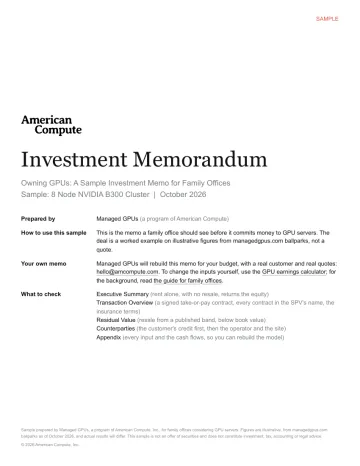
Free PDF · October 2026 · Illustrative figures
Plan a deployment for your family office.
- A call with our CTO about what you need
- Ballpark costs and timelines for your budget
- A straight answer if it’s not a fit
Prefer email? hello@amcompute.com
Questions from family offices
- What return do GPU servers earn?
- It depends on the price paid, the contract rate, and how much of the time the GPUs are rented. We don’t promise returns. Run your own numbers in the GPU earnings calculator, and we’ll model a base case and a downside case for your budget.
- What happens when the contract ends?
- Renew it, rent the GPUs short-term, sell the servers, or upgrade. A server usually takes about 30 days to sell on the secondary market.